UART (Universal Asynchronous Receiver/Transmitter)
This method has long been used as an interface between personal computers and peripheral devices. Although the communication speed is relatively slow, it only requires one transmit line and one receive line in addition to a common ground level, making it suitable for many applications where high-speed transfer is not necessary. In this communication scheme, both the transmitter and receiver have their own timers and perform data transmission or reception at predetermined intervals.
-
Transmission
The initial signal must always be at a high (H) level, and the start of transmission must begin with a transition to a low (L) level. After that, data is transmitted one bit at a time at predetermined intervals. Whether the data is sent starting from the most significant bit (MSB) or the least significant bit (LSB) must be agreed upon in advance between the communicating devices. After transmission is complete, the signal must return to the high (H) level. Additionally, a parity bit can be appended to the end of the transmitted data to allow the receiver to check whether the received data is correct.

Figure 2.1 Example of UART Transmission Format -
Reception
Since the initial signal level must always be high (H), the receiver continuously waits for the signal to transition to low. This falling edge acts as a trigger to start the reception timer, which then captures data at predetermined intervals and bit lengths. Once all data has been received, the signal line returns to the high (H) level. Confirming this high level indicates that transmission and reception are complete. However, if for any reason the final signal level is not high, a framing error occurs, and error handling—such as requesting retransmission of the data—is required.
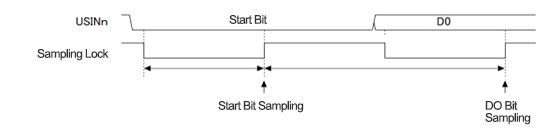
Figure 2.2 Example of UART Reception Sampling Timing
Next Column : What Is SPI? Types and Characteristics of Serial Interfaces in Microcontrollers (MCUs)