About LCD drivers
An LCD (Liquid Crystal Display) consists of liquid crystal material sandwiched between glass plates, with wiring that allows an electric potential to be applied across both sides. Liquid crystals are substances that, while in a liquid state, possess a crystalline structure. When a voltage is applied to the liquid crystal, its molecular structure changes, enabling it to either block or transmit light. Therefore, by controlling the voltage applied to the liquid crystal, it can be used as a display medium.
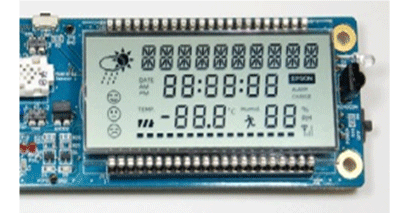
LCDs have low power consumption and have been widely used in displays for battery-operated portable devices, including digital watches. Although monochrome LCD panels may now be associated with inexpensive products, digital watches released in the 1970s were equipped with monochrome LCD panels, enabling numerical time displays instead of traditional analog hands. At the time, these watches were revolutionary and very expensive.
Drive method using an MCU with a built-in LCD driver
In the case of a simple matrix LCD panel, the signal lines connected to both electrodes of each liquid crystal segment are arranged in a matrix pattern, and display control is achieved by controlling these terminals. The SEG and COM terminals of an MCU with a built-in LCD driver are directly connected to the LCD panel.
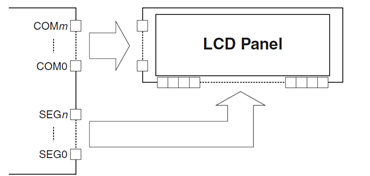
Since the SEG and COM terminals are connected to both electrodes of each liquid crystal segment, when the potential difference exceeds the display threshold of the LCD panel, each segment of the LCD turns on. Electrically, liquid crystals exhibit capacitor-like characteristics, so even when there are moments with no applied voltage, the display does not disappear instantly. Taking advantage of this property, display is achieved by repeatedly applying momentary voltages to each liquid crystal segment.
Additionally, continuously applying voltage in the same direction causes deterioration of the liquid crystal, so the polarity of the applied voltage is periodically reversed.
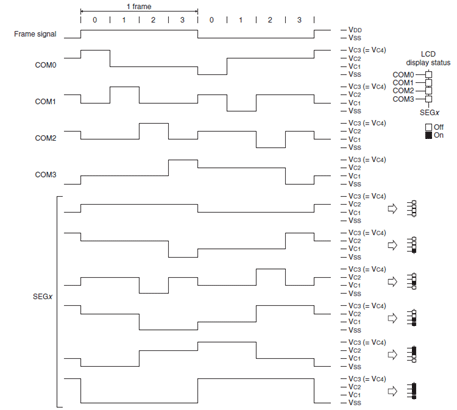
Epson's S1C17W/M series and S1C31W series are equipped with LCD drivers, enabling easy control of LCDs.
About LED drivers
An LED (Light Emitting Diode) is a type of diode and a semiconductor device that emits light when a forward voltage is applied. In general, LEDs can produce high brightness with low power consumption. Additionally, to represent numbers and some alphabetic characters, there are 7-segment LEDs arranged in a figure-eight configuration.
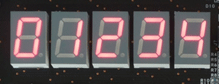
The advantage of LEDs is their high visibility. In the case of LCDs, natural light, ambient lighting, or backlighting is required for visibility. In contrast, LEDs are self-emissive, making them clearly visible even in the dark.
However, while LEDs used as lighting devices are considered to have low power consumption, in battery-powered devices such as portable equipment, the current flowing through the LEDs can be relatively high, which poses a challenge for battery life.
Driving method using an MCU with a built-in LED driver
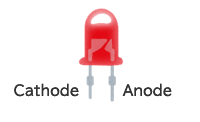
An LED emits light when current flows from the anode to the cathode. In a 7-segment LED, the signal lines connected to both electrodes of each segment are arranged in a matrix pattern, and by controlling these signal lines, it is possible to light the LED. This driving method is called the dynamic driving method.
Because the current flowing through an LED is relatively large, it is often difficult to drive it using only the general-purpose I/O ports of an MCU. In such cases, it is necessary to connect external components such as transistors to the MCU to amplify the current.
However, with MCUs that have a built-in LED driver, such as Epson's S1C17M12/M13, it is possible to directly drive LEDs by simply adding a resistor (for current limiting), without the need for external transistors.
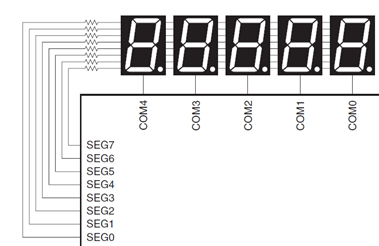
In a microcontroller that incorporates an LED driver, each terminal of the LED is connected to SEG and COM terminals. For each LED segment, current flows and the LED lights up at the moment when the potential difference reaches the level between VDD and VSS. In the case of dynamic driving, there are moments when the LED briefly turns off. However, due to the persistence of human vision, it can be perceived as continuously lit. That said, if the cycle becomes too slow, it will appear as flickering.
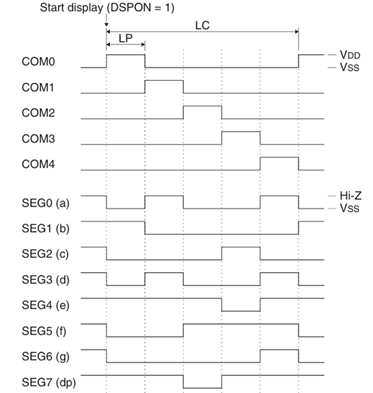
The LED driver built into Epson's S1C17M12/M13 generates such waveforms in hardware, making it easy to control LEDs.
About the EPD Driver
EPD (Electronic Paper Display) is a display device that is as thin as paper and can be used with some degree of flexibility. Another key feature is that once the display is updated, it can retain the image without requiring continuous electrical control. Therefore, the display can maintain its content with virtually zero power consumption, making it highly suitable for products that demand ultra-low power usage.
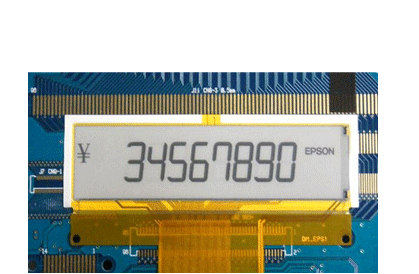
These panels are extremely thin and do not require power to maintain the displayed content. Typical applications include high-resolution dot-matrix displays such as e-book readers, and segment-type displays such as cards.
Driving Method Using a Microcontroller with Built-in EPD Driver
An EPD is controlled using terminals called the Top Plane (TP) and Back Plane (BP), along with Segment (SEG) terminals connected to each segment.
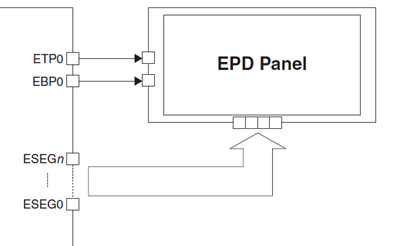
Epson's S1C17F57/F63 incorporates an EPD driver, enabling easy control of EPD display operation.