Overview and Key Features of Epson's Low-Power Microcontrollers
Epson offers low-power MCUs, which are suitable for battery-powered devices. The following features contribute to achieving low power consumption.
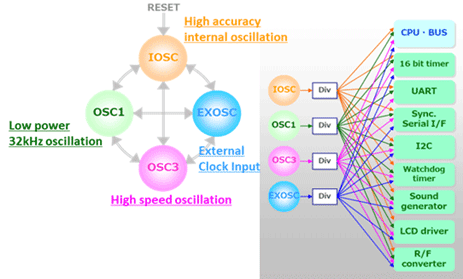
1. Flexible Clock Source Selection for Each Peripheral
Epson MCUs allow users to freely select the clock sources supplied to the CPU and peripheral circuits. This enables each circuit to operate at its suitable frequency, helping to minimize power consumption.
2. Low Current Leakage Process
The reduction of standby current is a key issue for high-integration LSIs and microcontrollers. Epson meets customers' needs for substantial reduction of standby current with its unique low current leakage process know-how.
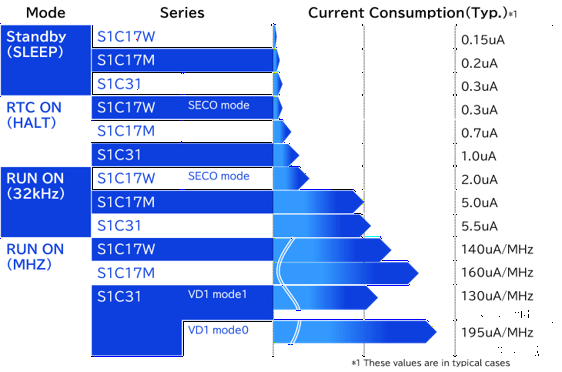
3. Operating modes
There are 3 operating modes(Sleep/Halt/Run) for Epson MCU and by selecting the appropriate mode for the CPU and peripheral circuits based on the processing requirements, unnecessary operation of these components can be avoided. This reduces power consumption and enables low-power operation of the entire system.
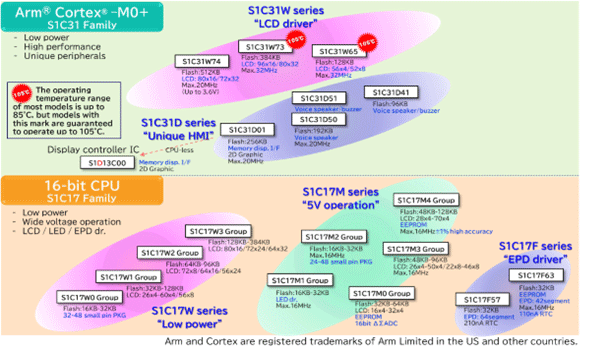
There are mainly two product families,S1C17 family and S1C31 family, which are classified by the CPU types. Each product family is divided into several series based on specifications.
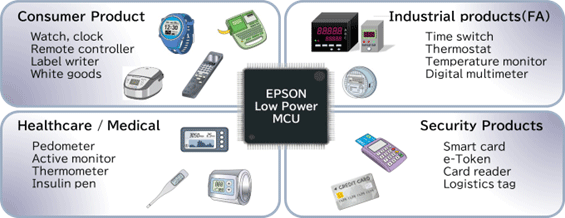
Examples of applications for Epson’s Low Power MCUs
The following applications are examples of applications.
Wearable: Watch, sports watch, bike computer
Wearable devices need to operate for long periods on a small battery while continuously providing functions such as time display and sensor monitoring. In addition to reducing standby current through a low-leakage process, Epson MCUs integrate LCD drive and various timer functions, allowing the CPU to remain in sleep mode for extended periods. With a timekeeping current of just 0.3 µA, they help reduce the frequency of battery replacement and make products smaller.
Consumer: White goods, Remote control, label writer
In consumer electronics, long-term battery operation and reduced standby power have a direct impact on energy efficiency and usability. Remote controls and label printers in particular spend far longer in standby than in active use, so the microcontroller's standby current consumption directly determines battery life. Epson MCUs minimize standby current consumption to as low as 0.1 µA through low-leakage technology, and by integrating an LCD driver and a range of peripheral circuits, they reduce the component count while keeping power consumption low.
FA/Household: Time switch, thermostat, multimeter, door lock
Because FA devices perform continuous monitoring and measurement, their power-saving performance has a major impact on maintenance costs and the frequency of battery replacement. Epson MCUs integrate RTC, high-precision measurement circuits, an R/F converter, and more, delivering high-precision control and measurement without adding external circuitry. In addition, offloading processing to various hardware circuits shortens CPU active time, contributing to longer operating life for industrial equipment and battery-powered devices that must run over extended periods.
Healthcare: Thermometer, pedometer, blood pressure monitor
Healthcare devices must be compact and lightweight with a long battery life, all while remaining in a standby state that allows measurement at any time. Epson MCUs prevent battery drains during standby through their low-current design, and by making use of the analog circuits and timer functions required for measurement, they enable efficient sensing that also keeps power consumption low during measurement — enhancing convenience for the user.
Security: Smart cards, E-token, logistic tag
Security devices such as smart cards, authentication tokens, and logistics tags must keep operating reliably for years on a strictly limited battery capacity. Epson's microcontrollers integrate an electronic paper (EPD) driver and a real-time clock, so display retention and timekeeping continue even while the CPU is stopped. With clock control on a per-peripheral basis, they achieve current consumption as low as 0.1 µA in SLEEP mode and 0.2 µA with the RTC running. Built-in tamper protection for Flash memory rounds out a solution offering both long operating life and robustness.
Epson Low Power MCU Lineup
| Product series | Overview | Main applications | Features |
|---|---|---|---|
| S1C17W00 Series | 16-bit low-power MCU | Remote controls, wearable devices, thermometers |
Supports 1.2 V operation, integrated high-efficiency DC-DC converter, on-board LCD driver, ideal for long-lasting battery-powered operation |
| S1C17M00 Series | Application specialized 16-bit MCU | Industrial equipment, measurement equipment, control equipment | Supports 1.8V~5.5V operation, compatible with LCD・LED control |
| S1C17F00 Series | 16-bit MCU for electronic paper display(EPD) | OTP cards, logistics tags, electronic labels | Integrated EPD driver, power supply circuit, temperature sensor |
| S1C17 Long-running Series | Long-running 16-bit MCU | Watches, remote controls, healthcare devices | A lineup offering a wide range of specifications, such as Flash memory size and operating clock frequency |
| S1C31D00 Series | 32-bit MCU with audio playback function | Water heater remote controls, fire alarms, electronic locks, home appliances | Dedicated processor for audio playback, 2ch audio playback, voice speed conversion, voice pitch conversion |
| S1C31W Series | 32-bit MCU with integrated high resolution LCD driver | FA equipment, industrial equipment, wearable devices, control panel | Integrated LCD driver , support 105℃ operation |
| S1C31D01 | Memory display controller integrated MCU | GPS watch, diving devices, healthcare devices | Integrated memory display interface, graphic controller, and memory display power supply |