Functional Safety in HUD Displays and Epson's Approach to "Correct Display" in Display Controllers
Background: ISO 26262 and Functional Safety in HUD Displays
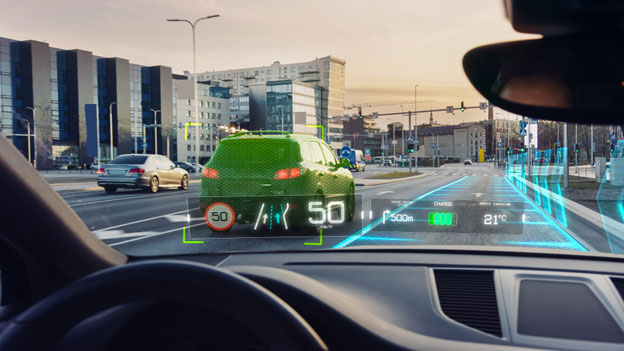
The Head-Up Display (HUD) is responsible for presenting safety-critical information such as vehicle speed, ADAS warnings, and vehicle status. ISO 26262, the international standard for functional safety of electrical/electronic (E/E) systems, defines requirements throughout the entire lifecycle of E/E systems to reduce the occurrence of hazardous events. Automotive displays fall within this scope. In addition to improving visibility, ensuring how to guarantee a "correct display" has become a key challenge.
What Is ISO 26262?
ISO 26262 is an international standard designed to ensure functional safety of electrical and electronic systems installed in automobiles. It covers the entire product lifecycle-from concept and early development stages to system, hardware, and software design, verification, production, operation, and decommissioning. Through Hazard Analysis and Risk Assessment (HARA), the standard defines Automotive Safety Integrity Levels (ASIL A-D). By specifying safety requirements and development processes appropriate to each level, the standard aims to ensure that, even in the event of a failure, the risk of harm to people is kept within an acceptable range.
What Is Functional Safety in HUD Displays?
Functional safety for Head-Up Display (HUD) systems refers to the mechanisms that ensure driving information, warnings, navigation guidance, and other content presented to the driver are always displayed correctly and without causing misunderstanding. Because the HUD overlays information onto the driver's forward view, incorrect display, delays, or missing information can immediately lead to safety risks. Therefore, depending on the required ASIL level defined by ISO 26262, HUD systems must incorporate data consistency checks, redundancy, self-diagnostic functions, and fail-safe behaviors. These measures ensure that drivers continuously receive reliable visual information.
Technical Approaches to Ensuring a "Correct Display"
- End-to-End Assurance from Video Source to Display Output
- Redundancy and Consistency of Source Signals: Add CRC and sequence management to the ECU input signals, and detect cycle monitoring and timeouts on the receiving side.
- Monitoring of the Rendering Pipeline: Monitor the state of data immediately before and after OSD composition, layer management, and alpha blending.
- Monitoring of Video Transmission Paths: Perform synchronization-loss detection and frame-level CRC video data checks between the SoC -> display controller -> panel.
- Direct Monitoring of Displayed Video (Telltale Monitoring)
- Telltale Monitoring: Hardware monitoring of designated telltale areas, checking whether the displayed content matches the expected values.
- Notification and Override in Case of Abnormalities: Trigger interrupts and, as a fail-safe action, forcibly overwrite the telltale graphics or display an error message.
- Fail-Safe Display and Immediate Driver Notification
- Display telltales or error messages when abnormal video output is detected.
- Perform self-checks for LED and pixel defects through a startup lamp test.
Epson Display Controllers Supporting "Correct Display"
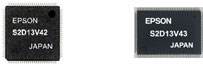
Epson's HUD-oriented display controllers, S2D13V42 / S2D13V43, provide image-processing capabilities such as warping correction and pitch correction, while also incorporating display-safety functions that support the technical approaches described above. In particular, the S2D13V43 is planned to comply with ISO 26262 ASIL-B and supports system-level functional safety by offering display-safety functions such as error detection and OSD, in addition to local dimming technology that improves contrast and visibility.
Conclusion
Ensuring a "correct display" is not merely about improving visibility; it is achieved through comprehensive video-data validation covering the entire path from the video source to the final display output. Epson's display-safety functions in the S2D13V42 / S2D13V43 support this approach at the hardware level, enhancing display reliability. This enables the delivery of critical information to the driver with certainty, realizing a HUD solution that balances both safety and comfort.
OpenLDI (Open LVDS Display Interface):
- Based on LVDS (Low Voltage Differential Signaling). Offers high noise immunity and is suitable for long-distance transmission. Serial transmission reduces wiring complexity. Widely used in automotive displays and industrial/medical equipment.
Glossary
- ECU (Electronic Control Unit)
A computer that controls various vehicle functions. It serves as the central unit generating display signals for meters and HUDs. Redundancy and diagnostic functions are essential for ensuring safety. - OSD (On-Screen Display)
A mechanism for overlaying warning lamps and icons. Proper layer management and rendering-cycle monitoring are key to preventing incorrect display. - CRC (Cyclic Redundancy Check)
A method for verifying data integrity during transmission.
Documents related to Display Controller IC/Interface IC for Automotive
You can request the following documents related to Display Controller/Interface IC for Automotive. Please feel free to request.